
By Umer Usman, Founder and CEO of OnePitch
For years, PR and SEO lived in different departments. PR chased headlines and brand awareness. SEO chased keywords and backlinks. They rarely talked to each other, and nobody saw a problem with that.
In 2026 that split has stopped making sense. The way people find businesses has changed. More and more answers now arrive inside Google’s AI Overviews, ChatGPT, Gemini and Perplexity, often before anyone clicks a link. Those systems build their answers from what the rest of the web says about you. That is, more or less, the definition of PR.
This guide explains what changed, what the research says, and a practical playbook for making press coverage and SEO work as one plan.
What changed in search
The short version: people click less, and machines summarise more.
Ahrefs found that as of December 2025, the presence of an AI Overview cut the click-through rate for the number one organic result by about 58%. Ranking first used to guarantee a steady stream of visitors. Now a large share of searchers read the AI summary and stop there.
Big publishers are feeling it. Reddit, which is one of the most-cited sources in AI answers, reported in late 2026 that it was getting over a million fewer search referrals a week, and its CEO named Google’s AI features as the main suspected cause. If a site that size can lose search traffic to AI summaries, a small business certainly can.
This does not mean search is dead. People still search to compare, buy and hire. But the question is no longer only “Where do I rank?” It is also “When an AI tool answers a question in my industry, does it mention me?”
Why AI answers favour brands that get written about
AI search tools do not rank websites the way Google’s classic results do. They pull together an answer from many sources and name the brands that appear most often, and most credibly, across those sources.
The data on this is fairly consistent:
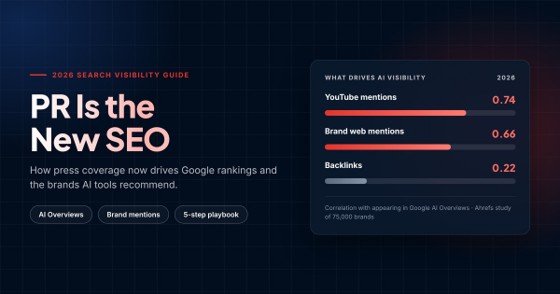
- Brand mentions beat backlinks for AI visibility. In Ahrefs’ study of 75,000 brands, branded web mentions showed a correlation of about 0.66 with appearing in Google’s AI Overviews. Backlinks came in at around 0.22. YouTube mentions were even stronger, at around 0.74.
- Being searched for by name matters. A Semrush citation study found brand search volume to be the strongest single predictor of whether an AI model mentions a brand.
- Each AI tool picks differently. BrightEdge found that Google’s AI Overviews and ChatGPT disagreed on which brands to name 61.9% of the time. AI Overviews averaged about six brand mentions per query, while ChatGPT averaged just over two.
Put those together and a clear pattern appears. AI systems trust brands that other credible sources talk about. One great page on your own website is not enough. You need to be discussed elsewhere: in news articles, trade publications, podcasts, videos and community threads.
That is exactly what good PR produces.
What still matters for classic Google rankings
None of this means links stopped mattering. For Google’s traditional results, links from relevant, trusted sites still help a page rank. What changed is how much quality matters compared with quantity.
Google is also clear about what it does not want. Its spam policies describe buying or selling links for ranking purposes as link spam. The same policies say Google understands that paid placements are a normal part of advertising on the web, and that paid links are fine when they are marked with rel=“sponsored” or rel=“nofollow”. Keyword-stuffed links inside press releases and mass guest posts are named as examples of link spam too.
So the old shortcut of blasting a press release to hundreds of sites and hoping the links lift your rankings is not just weak. It can be risky. The value of a press placement today comes from other places: the audience it reaches, the credibility it adds, the brand mention AI tools can pick up, and the readers who click through.
A practical playbook: making PR and SEO one plan
Here is the process we use with agencies and brands. It works for a small business with a modest budget as well as for larger teams.
Step 1: Choose publications your buyers and AI tools both read
Before buying or pitching anything, ask two questions about each outlet. Do my potential customers actually read this? And does this site show up as a source in AI answers for my industry?
A simple test: ask ChatGPT, Perplexity and Google a few questions your customers would ask, such as “best accounting software for freelancers” or “how to choose a PR agency.” Note which websites are cited. Those are the outlets that already shape AI answers in your space. We walk through this test in more detail in our guide to getting your brand mentioned in ChatGPT and Google AI.
One placement on a respected trade or news site usually does more than twenty on sites nobody reads.
Step 2: Describe your brand the same way everywhere
AI tools get confused by mixed signals. If your website calls you a “growth platform,” your LinkedIn says “digital agency” and a press article calls you a “marketing startup,” the model has three different stories to reconcile.
Pick one clear description, such as “a white-label PR agency for marketing agencies,” and use it on your site, your social profiles, your press bios and every article that mentions you. Consistency is boring, but it is one of the cheapest ways to improve how AI describes you.
Step 3: Give each mention a strong page to point to
When an article mentions you, the link (if there is one) should go to a page that deserves it: a clear service page, a useful guide or an “about” page that explains who you are. Sending every link to your homepage wastes the chance to build authority around the topics you actually want to be known for.
Step 4: Be honest about sponsored content
If you pay for a placement, accept that the link should be marked as sponsored, and judge the placement on everything else it brings. Ask the seller up front whether the link is sponsored, nofollow or do-follow, and whether the article will be indexed by Google. A reputable provider will tell you before you pay.
Step 5: Repeat steadily rather than all at once
Ten mentions spread over six months look natural and keep your brand fresh in the sources AI tools read. Ten mentions in one week, followed by silence, look like a campaign and fade quickly. A steady rhythm also gives you time to learn which outlets actually move the needle.
Common mistakes to avoid
- Chasing domain authority alone. A high DA score means little if the audience is irrelevant or the article is buried on a page nobody visits.
- Mass press release distribution. Syndicated releases rarely get read, and keyword-stuffed links in them are exactly what Google’s spam policies warn against.
- Writing for the link, not the reader. Thin, promotional articles get ignored by readers and are less likely to be used by AI tools as a source.
- Forgetting your own site. Coverage brings people and AI crawlers to your website. If your pages are slow, vague or out of date, you lose the benefit.
How to measure whether it is working
Traffic alone no longer tells the full story, so track a few signals together:
- Branded searches. In Google Search Console, watch how many searches include your brand name. Growing branded demand is one of the clearest signs PR is working.
- AI impressions. Search Console now has a generative AI report that shows how often your pages appear in AI Overviews and AI Mode. It shows impressions rather than clicks, but it tells you which pages AI is drawing from.
- Monthly prompt checks. Ask the same ten questions in ChatGPT, Perplexity and Google each month, and record whether your brand appears and which sources are cited.
- Referral traffic and leads. Check which articles send visitors who actually contact you or buy.
The bottom line
Search in 2026 rewards brands that are known, not just brands that are optimised. Google still values quality links, and AI tools increasingly value being mentioned by credible sources. Press coverage is one of the few things that serves both at once.
The businesses that win will stop treating PR and SEO as separate line items. They will plan them together: pick the right outlets, say the same thing everywhere, point mentions to strong pages, stay honest about sponsored content and keep showing up month after month.
Umer Usman is the founder and CEO of OnePitch, a white-label PR agency that helps marketing agencies and brands get featured in established publications.