Introduction
The majority of us didn’t quite intend to let technology invade our lives; rather, we have been gradually engulfed by it. It is just a matter of fact that we may matter-of-factly look at our phones before greeting anyone else at home! New means of communication have defined the way we speak to each other and work, as well as how we learn, shop, or rest. The whole transformation process is so gradual that it becomes impossible to determine what is “normal” anymore! Cloud computing, connected devices, faster internet — these things keep reshaping daily life in ways that are easy to miss until you actually stop and look. There are real upsides here, no question. Trade-offs too, though, and they’re worth talking about honestly instead of just celebrating every new gadget that shows up. That’s really the goal with this piece — looking at both sides of how tech is changing the way we live, work, and learn.
Table of Contents
Technology in Daily Life
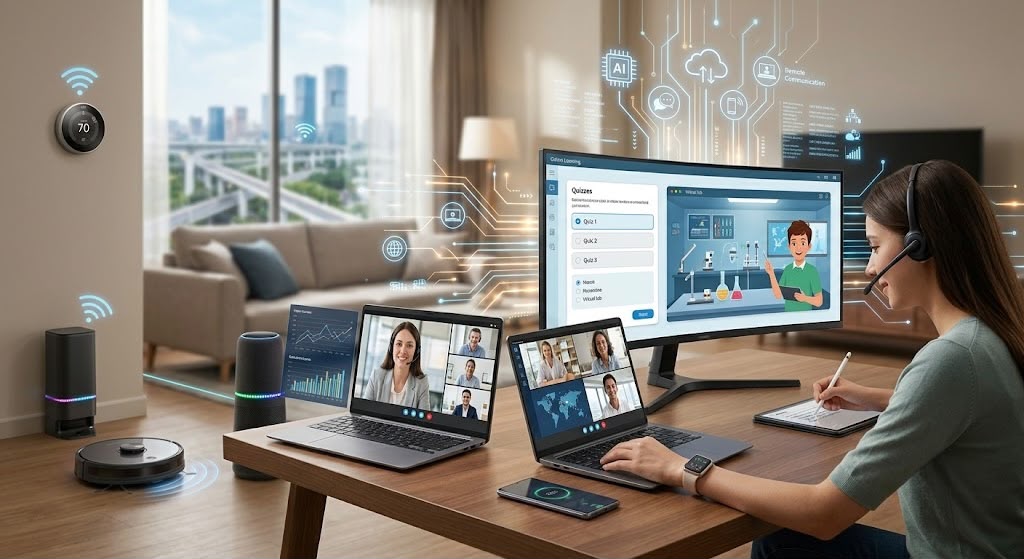
The majority of the convenience that we are using today is such that we have forgotten about it completely. Simply speaking, smart devices assist us in organizing, monitoring our health, and operating household appliances with the help of voice commands.
Some examples that people use unconsciously include smart home systems that adjust lighting, safety, and temperature; banking applications that perform transactions almost instantly; GPS systems that reroute our trips as soon as we encounter traffic. Add food delivery apps for the nights cooking just isn’t happening, and wearables quietly tracking fitness and health in the background.
None of this feels exciting day to day anymore — it’s just how things work now. But it adds up. Homes and entire cities keep getting smarter and more connected, often in ways we only really register once we pause and think about it.
How Technology Is Transforming the Workplace
Offices really don’t look the way they used to, not even close. A decade ago, remote work was something you had to justify to a manager, whereas now it’s practically expected across a lot of industries. Businesses lean heavily on technology these days to keep productivity up, communication smooth, and collaboration working across scattered teams without much friction.
Cloud tools and video calls made physical location matter a lot less. Teams can get real work done together without ever sharing a desk, which honestly would’ve sounded borderline impossible not that long ago.
Automation has quietly taken over a lot of the repetitive stuff too — data entry, answering the same customer questions over and over, tracking inventory, running email campaigns, pulling together reports. It’s not glamorous work, but offloading it frees people up for things that actually need real thinking.
Artificial Intelligence
AI has basically become an office assistant nobody formally hired. The technology examines the data, creates reports, answers consumers’ inquiries, and sometimes even guides business choices. However, it does not yet replace the workforce entirely. It’s more like it’s absorbing the tedious parts so people can spend their energy on work that actually needs judgment and creativity.
Technology Is Revolutionizing Education
Education has arguably changed more than almost any other sector, and honestly, it probably needed to. Learners are no longer bound to a physical classroom. They can access educational materials at any time using applications and online platforms.
Virtual learning made things far more flexible than the old model ever was. Students can participate in live classes from the comfort and convenience of their homes, revisit lectures that they may have missed or otherwise didn’t follow the first time, send assignments without needing a printer, and go through their studies at their own pace. Such situations led to more individuals being able to receive a decent education who otherwise wouldn’t have had access to it.
Nowadays, studying solutions are more appealing than ever before—thanks to such forms of learning as videos, interactive tests, virtual labs, and gamified classes. These techniques keep learners interested in getting knowledge so that they don’t walk out during the class.
Personalized Education
Some platforms now track exactly where a student’s struggling and adjust the material accordingly. More practice becomes available when someone struggles with a theme and progresses further once understanding is achieved. While it is not perfect, it is better than the cookie-cutter method many of us were brought up with.
Technology and Communication
Calling family overseas used to be expensive enough that people scheduled it around off-peak hours to save money. Today, you can make video phone calls freely, which is a minor occurrence but gives proof of the tremendous advancements accomplished.
Nowadays, people contact each other very easily since there are various modes to communicate with. Different families, which live on the other side of the planet, are now able to stay in contact with one another. At the same time, entrepreneurs manage to communicate with their clients regardless of the time zone they are in. Even with all its flaws, social media enabled small businesses and people to connect with an audience they could not contact before.
Technology in Healthcare
This is probably where tech has made the most obvious difference, honestly. Health facilities tend to rely on electronic information instead of paper documentation, which can get misplaced or destroyed. Procedures using robots to help out during surgery have increased accuracy in ways that were previously impossible.
AI can even catch things in medical scans that a tired human eye might miss late into a long shift.
Telemedicine especially has changed things for people who don’t live anywhere near a proper hospital. A video call with a doctor instead of a multi-hour drive — that’s not a small thing if you’re in a rural area.
Moreover, wearable technology has been invented for handling health issues of the present times, as it can easily monitor heart rates, sleeping habits, and even oxygen saturation without people even realizing it.
The Impact of AI
People may not realize that AI has always existed. Voice assistants, recommendation systems, translation tools, fraud detection quietly working every time you swipe a card, smart search that somehow knows what you meant to type — it’s woven into so many everyday interactions that most people don’t even register it as “AI” anymore. It’s just how apps work now.
Businesses use it to process huge amounts of data quickly, which helps with decisions and generally improves the customer experience. Where all this goes next is genuinely hard to say, but it’s safe to bet AI isn’t going anywhere.
Challenges of Technology
It’s not all good news, though, and pretending otherwise wouldn’t really be honest, given how many real trade-offs come along with all this convenience.
Issues Regarding Privacy
Nowadays, companies gather a very large amount of personal information, and let’s be fair, most individuals don’t really know how that data is processed or who can use it.
Read More: AI Agents Are Replacing Your To-Do List, Not Your Job
Cybersecurity Risks
Data breaches, phishing scams, identity theft — these threats keep growing, not shrinking. Strong cybersecurity isn’t optional anymore; it’s basically a baseline requirement for any business handling customer information.
Digital Divide
Not everyone has access to fast internet or a decent device. A gap in access leads to real consequences in terms of education, career opportunities, and everything else that technology ought to help. If you’ve got a good connection yourself, it’s easy to overlook this.
Screen Time
Too much time on screens brings its own baggage — eye strain, worse sleep, less movement, and for some people, genuine mental health struggles. Balancing tech use with actual offline life matters more than it usually gets credit for.
The Future of Technology
Looking ahead, there’s a lot brewing: quantum computing, 6G networks, smart cities, self-driving cars that might actually become normal someday. Add to that AR and VR moving past gaming into practical everyday tools, and green technology trying to undo some of the environmental damage caused along the way.
Whether all of it plays out the way experts predict is hard to say for sure, but staying adaptable and picking up new skills as things shift will probably matter more than trying to master every single tool that comes along.
Conclusion
Technology has transformed our lives, professions, and schools more than we could’ve imagined recently. We can communicate quicker and conduct businesses better, and education and health care have introduced people to opportunities they had never had before. Still, many challenges concerning privacy, safety, and accessibility should definitely not be ignored. But on the right side, the advantages of technology can outweigh the downsides. In the end, we should stay curious and never let technology dictate our lives to us.