
A few years back, opening an account or reporting any strange activity required manual checks and interaction with chatbots which could respond to questions programmed into their system. These systems improved the accessibility of the fintech industry, yet their capabilities stopped where their rule-based automation reached its limits. Due to this, financial-related queries are still dependent on human intervention for complicated decisions and multi-purpose coordination.
As we enter the period of 2026 and onwards, there have been significant changes in the functioning of financial institutions. AI has ceased to remain confined to answering questions and performing mundane tasks. The emergence of the next generation of intelligent machines can be witnessed, which will be capable of understanding objectives, analyzing financial data, and executing financial processes. These AI agents in fintech operate as autonomous participants within financial institutions. They help financial institutions make faster, smarter, and more context-aware decisions.
This evolution marks a major transformation for fintech. As embedded finance, decentralized finance (DeFi), digital payments, open banking, and regulatory requirements. These all continue to expand; businesses need AI that can reason, adapt, and act, not just respond like a machine. In this article, explore what agentic AI is in fintech, why the rise of agentic AI is driving quickly, how it moves beyond traditional chatbots and automation, and trends shaping the future of intelligent finance services.
Table of Contents
Understanding Agentic AI in Fintech
Agentic AI in fintech refers to an autonomous system that goes beyond single-task execution. These agents can understand goals, design execution plans, and seamlessly coordinate with different tools and data sources. They are proficient in making more informed decisions while constantly adapting to dynamic financial conditions. Unlike traditional AI solutions where each task is performed individually, Agentic AI servicesare in charge of performing the full workflow according to defined business, governance, and regulation standards.
This revolution is made possible by the development of technologies such as large language models(LLMs), retrieval-augmented generation (RAG), Model Context Protocol (MCP), vector databases, multi-agent systems, and event-driven architecture. Such technological innovations help fintech platforms evolve from simple automation to intelligent systems for fraud detection, loan underwriting, payment optimization, and regulation compliance. Agentic AI has redefined the operation of financial technology platforms since 2026.
Why 2026 Marks the Rise of Agentic AI in Fintech
Adoption of agentic AI in the year 2026 is now essential from a strategic standpoint. Financial institutions must manage their ecosystems which include open banking, e-wallets, blockchain systems, embedded finance, real-time payments, and other regulatory changes.
Traditional automation fails to match up to the increasing degree of interconnectedness since it relies heavily on fixed workflows and fixed decision rules. Simultaneously, recent developments in large language models, enterprise AI orchestration, AI governance, and collaboration among multiple agents make agentic AI possible in production environments.
Organizations today have started focusing on attaining certain business results rather than automation of individual tasks. This change can be seen in the field of finance and banking sector where investments in AI-based automation is increasing. According to Capgemini’s World Cloud Report in Financial Services 2026, 80% of financial services firms are already in the ideation or pilot stage of AI agent deployment, while only 10% have implemented AI agents at scale—highlighting both the growing momentum and the significant opportunity ahead.
As a result, Agentic AI in fintech has emerged as a foundational capability for building intelligent, adaptive, and scalable financial platforms that can support the next generation of digital banking and financial services.
Technologies Driving the Rise of Agentic AI in Modern Fintech
The rise of agentic AI is generally supported by a merging of advanced technologies that enable AI systems to reason, collaborate, and execute the most difficult financial workflows. Fintech platforms use different AI capabilities within one system architecture to provide safe and autonomous decision-making.
Large Language Models (LLMs)
Advanced LLMs respond to financial queries, examine complex documentation, generate reports, and coordinate actions throughout enterprise applications. In the fintech sector, they do everything from investment research and financial planning to intelligent customer interactions and regulatory compliance reporting.
Enterprise-level models are increasingly deployed via confidential infrastructure or secure cloud environments. This ensures sensitive financial information stays secure while maintaining high performance and compliance.
Small Language Models (SLMs)
Not every financial task requires a large AI model. Small Language Models are the most important part of enterprise AI as they provide low latency, reduced operational costs, and greater efficiency for particular workloads.
These are specifically designed to categorize transactions, validate documents, route payments, score frauds and authenticate customers. These help fintech firms to handle large request volumes at faster response times with lower infrastructure costs.
Multi-Agent Systems
One of the unique features that makes an Agentic AI unique is the ability to work with multiple AI agents together.
Instead of assigning individual responsibility to a single model, specialised agents handle a wide range of business tasks. One agent might verify customer identity, another study fraud signals, another evaluates lending risk, and monitor regulatory compliance. These AI agents develop, continuously exchange information, and coordinate decisions before completing the financial workflow.
This distributed approach improves scalability, resilience, and accuracy in decisions while enabling the financial services industry to automate sophisticated business operations seamlessly.
Model Context Protocol (MCP)
AI agents are becoming more widely implemented with enterprise systems; maintaining consistent context also becomes crucial. MCP gives a standardized way for AI-based agents to securely access external tools, databases, APIs, and business applications. All done without relying on custom integrations for every service.
In the MCP ecosystem, it enables AI agents to retrieve customer records, access the banking system, query compliance databases, analyze transactional documents, and interact with payment channels. It helps in preserving governance controls and reliability. Hence, standardized connectivity will significantly simplify enterprise AI deployment.
Agent-to-Agent (A2A) Communication
Modern financial operations rarely rely on a single AI agent.It allows for specific AI agents to communicate with each other, delegate tasks, and coordinate complex decision making on the spot.
For example, let’s imagine that in a case of fraud analysis one agent will be responsible for studying behavioral deviations, the second agent will examine the transaction record, the third one will assess the risk level of the account, and the fourth will take necessary security measures.Therefore, through cooperation rather than working alone, these AI systems provide more rapid and precise outcomes within the financial domain.
Retrieval-Augmented Generation (RAG)
In order to make financial decisions, there is a need for credible information rather than just the information that the AI system is trained upon. The current technology enables AI systems to first retrieve accurate information from enterprise knowledge bases, regulations, and customer data before coming up with any suggestions.
This improves the factual accuracy in the regulated fields such as banking, wealth management, and insurance.
Vector Databases
Traditional databases store structured insights efficiently, but they cannot capture the semantic relationships that are needed for intelligent AI reasoning. However, vector databases solve this challenge by storing data as mathematical embeddings, allowing AI agents to retrieve contextual information that is relevant to the data almost instantly.
Vector databases in fintech are used for intelligent document search, customer knowledge retrieval, financial research, regulatory intelligence, and personalized financial advice by allowing AI to understand the meaning rather than using only keyword matching.
Event-Driven Architecture and AI Orchestration
Financial systems create hundreds of thousands of real-time events each day in the form of transaction requests, trading activities, fraud detection, and regulatory validation, among others. By using event-driven architecture, AI agents are able to respond immediately when there is creation of an event without the need to wait for the scheduled processing of the event.
The event stream platforms like Apache Kafka will enable the AI agents to process the events in real time. It becomes important for applications such as payment processing, fraud detection, and risk monitoring.
There are AI orchestration systems including LangGraph, CrewAI, AutoGen, among others which help to coordinate these intelligent agents, making sure that they work within governance policies and business strategies. All these tools enable the creation of an interconnected environment that can execute financial transactions end-to-end through AI capabilities.
How Agentic AI Moves Beyond Chatbots and Traditional Automation?
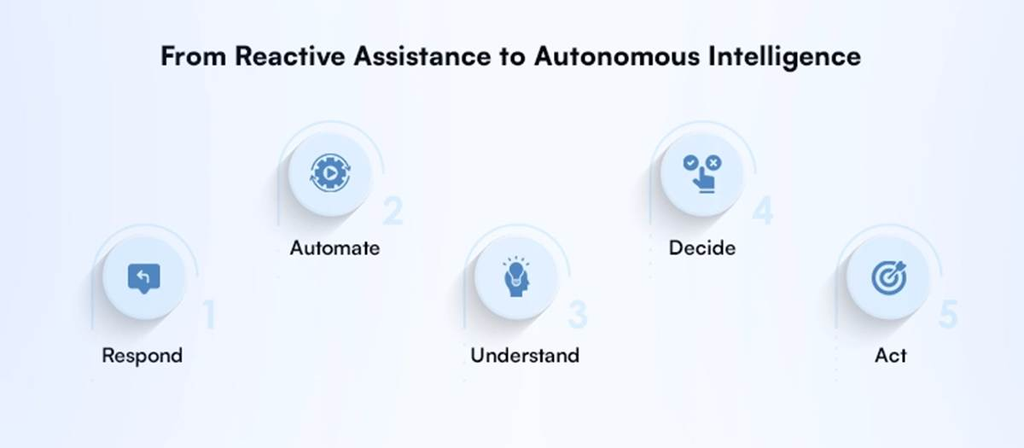
Traditional chatbots, dependent on fixed decision trees and standard automation, execute the stubborn rules. Agentic AI goes above: it sets instant goals, opts for tools, evaluates results, and adapts when the scenario changes. In 2026, this technology offers a different operational edge through the primary financial functions.
Real-Time Fraud Interception
Rather than raising passive notifications for human review, agentic systems deploy coordinated, specialized agents in parallel:
Pattern Monitoring: Track the live transaction flows by integrating agentic AI in fintech.
Context Analysis: Correlate gadget fingerprints, behavioural biometrics, and geolocation information.
Threat Intelligence: Queries real-time security feeds
When the irregulatrie srise, the system acts within milliseconds, freezing transaction ad request the step-up authentication and generating audit trails. To maintain control in banking services, all actions operate under Zero Trust Execution, need Human Escalation for high-risk settlements, and undergo continuous logic validation leveraging the synthetic attack tests.
Adaptive Credit and Lending
Static credit scoring is not relevant to dynamic assessment. Agents pull alternative data, evaluate live cash-flow patterns, model repayment within economic stress scenarios, and offer more customized loan terms.
Policy Boundation Freedom: Agents operate within predefined parameters, risks, and pricing bounds. They are routing exceptions to human underwriters.
Continuous Oversight: Tracking beyond disbursement, permitting agents to quickly find financial stress and suggest proactive restructuring options for unscorable borrowers.
Autonomous Payments and Embedded Finance
Buyer and seller agents bargain in supply chain and marketplace ecosystems, confirming delivery milestones through connected feeds and completing payments instantly. By using programmable payment rails such as stablecoins and tokenized deposits, multi-agent systems avoid any reconciliations across borders.
Guarded Authority: There are strict limits for transaction amounts and acceptable counterparties.
Fully Traceable: Each step in the negotiation process, sources used, and settlement instructions leave an immutable trail.
Real-Time Wealth Management and Compliance
Wealth agents serve as constant companions, balancing portfolios efficiently and generating new opportunities in finance. From the point of view of regulations, compliance agents automatically map newly implemented laws in various jurisdictions, adjust internal controls, and conduct policy impact simulations.
Explainability First: Each update of controls and recommendations leaves an immutable trail of reasoning.
Human Strategy and Direction: Agents take care of velocity of execution, while humans set goals and handle exceptions.
In all financial processes, agentic AI handles complex and repetitive decisions dynamically. The human is the ultimate authority, judgement, and oversight in financial systems.
Preparing a Fintech for an Agentic AI-First Future
The next stage of fintech innovation can be characterized by how well all tools work together in order to solve the emerging business challenges. The success will increasingly depend on implementing AI ecosystems that are modular and adaptable to new customer expectations and regulation changes.
Financial organizations must look at Agentic AI as an ongoing capability and not as just one-time integration. It involves building a solid data base, creating standardized API connectivity, leveraging cloud-native infrastructure, and focusing on continuous AI governance. They will determine how speedily businesses can scale the automnomiys tasks and also without compromising security or trust. AAt the same time, the process of upskilling teams to work with intelligent AI agents is going to be just as essential as selecting the technology stack for fintech app development.
In terms of the evolving industry standards, it is essential to pay attention to the cooperation between the financial services, technology firms, AI developers, and regulatory bodies in fintech. Organizations that involve this collaboration will accelerate product innovation, enhance operational resilience, and deliver more adaptive financial experiences.
For business who is looking to develop or want to get AI-driven financial platforms. Then need to partner with a 4.5+* rated fintech app development company. Get emerging Agentic AI features and future-ready solutions that are evolving with business goals.